
Data Module Integration Tests#
This notebook provides integration tests for the finm.data module by:
Pulling each data source
Creating simple visualizations
Calculating factor exposures for asset return data
Data Sources:
Factor Data: Fama-French 3 factors, Federal Reserve yield curve, He-Kelly-Manela factors
Asset Returns: Open Source Bond (treasury and corporate returns)
import os
from pathlib import Path

import matplotlib.pyplot as plt
import pandas as pd
from dotenv import load_dotenv

import finm
from finm.data import fama_french, federal_reserve, he_kelly_manela, open_source_bond

load_dotenv()

DATA_DIR = Path(os.environ.get("DATA_DIR", "./_data"))
DATA_DIR.mkdir(parents=True, exist_ok=True)

print(f"Data directory: {DATA_DIR}")
Data directory: /Users/jbejarano/GitRepositories/finm/_data
1. Fama-French Factors#
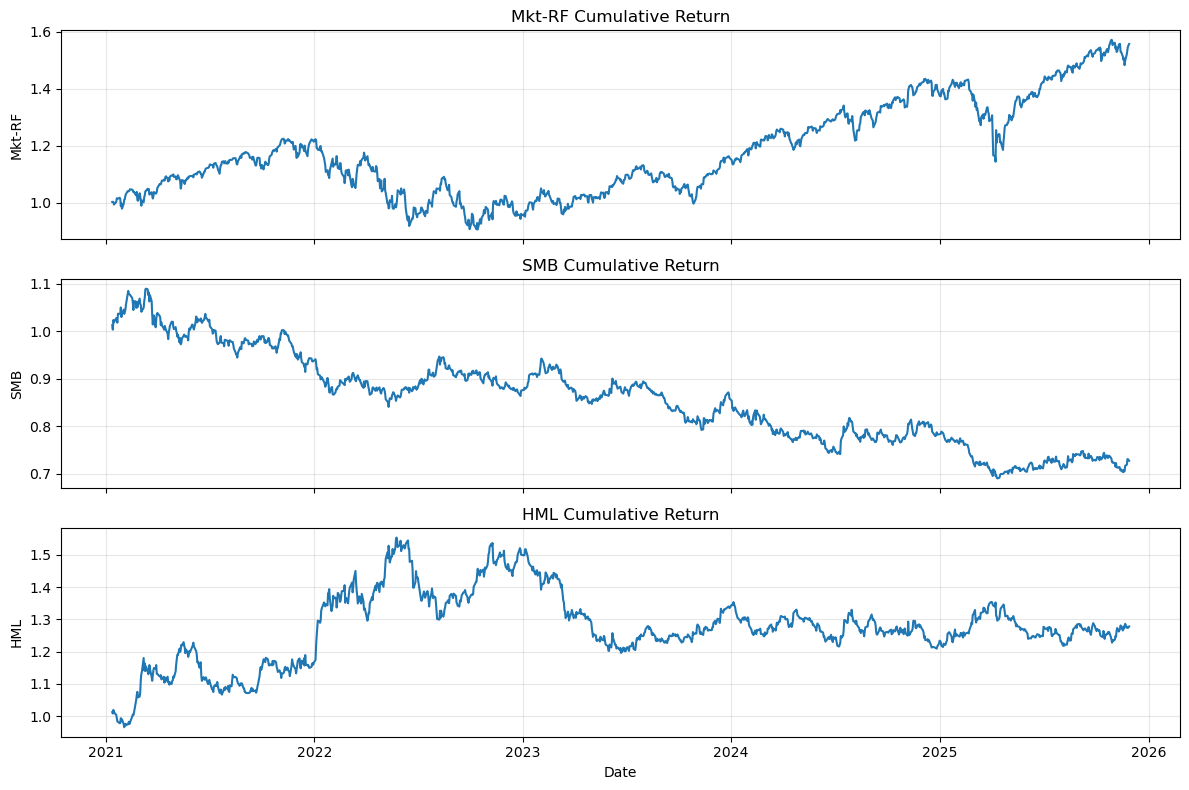
The Fama-French 3-factor model provides:
Mkt-RF: Market excess return
SMB: Small Minus Big (size factor)
HML: High Minus Low (value factor)
RF: Risk-free rate
# Load Fama-French data from bundled data (data_dir=None)
ff_factors = fama_french.load(
    data_dir=None,
).to_pandas()
ff_factors = ff_factors.set_index("Date")
print(f"Loaded Fama-French factors (converted to pandas DataFrame)")
print(f"\nFama-French factors shape: {ff_factors.shape}")
print(f"Columns: {ff_factors.columns}")
ff_factors.head()
Loaded Fama-French factors (converted to pandas DataFrame)

Fama-French factors shape: (1227, 4)
Columns: Index(['Mkt-RF', 'SMB', 'HML', 'RF'], dtype='object')
| Mkt-RF | SMB | HML | RF | |
|---|---|---|---|---|
| Date | ||||
| 2021-01-12 | 0.0037 | 0.0128 | 0.0124 | 0.0 |
| 2021-01-13 | 0.0006 | -0.0094 | -0.0045 | 0.0 |
| 2021-01-14 | -0.0012 | 0.0202 | 0.0113 | 0.0 |
| 2021-01-15 | -0.0086 | -0.0050 | -0.0074 | 0.0 |
| 2021-01-19 | 0.0092 | 0.0088 | -0.0079 | 0.0 |
# Plot Fama-French factors
fig, axes = plt.subplots(3, 1, figsize=(12, 8), sharex=True)

# Cumulative returns for each factor
for ax, factor in zip(axes, ["Mkt-RF", "SMB", "HML"]):
    cumulative = (1 + ff_factors[factor]).cumprod()
    ax.plot(cumulative.index, cumulative.values)
    ax.set_ylabel(factor)
    ax.set_title(f"{factor} Cumulative Return")
    ax.grid(True, alpha=0.3)

plt.xlabel("Date")
plt.tight_layout()
plt.show()
# Summary statistics
print("\nFama-French Factor Statistics (Daily):")
print(ff_factors[["Mkt-RF", "SMB", "HML", "RF"]].describe())
Fama-French Factor Statistics (Daily):
            Mkt-RF          SMB          HML           RF
count  1227.000000  1227.000000  1227.000000  1227.000000
mean      0.000424    -0.000233     0.000245     0.000129
std       0.011242     0.007336     0.009452     0.000092
min      -0.059200    -0.027000    -0.038900     0.000000
25%      -0.005150    -0.005200    -0.005500     0.000000
50%       0.000500    -0.000500    -0.000100     0.000200
75%       0.006600     0.004200     0.005800     0.000200
max       0.096500     0.036100     0.037100     0.000200
2. Federal Reserve Yield Curve#
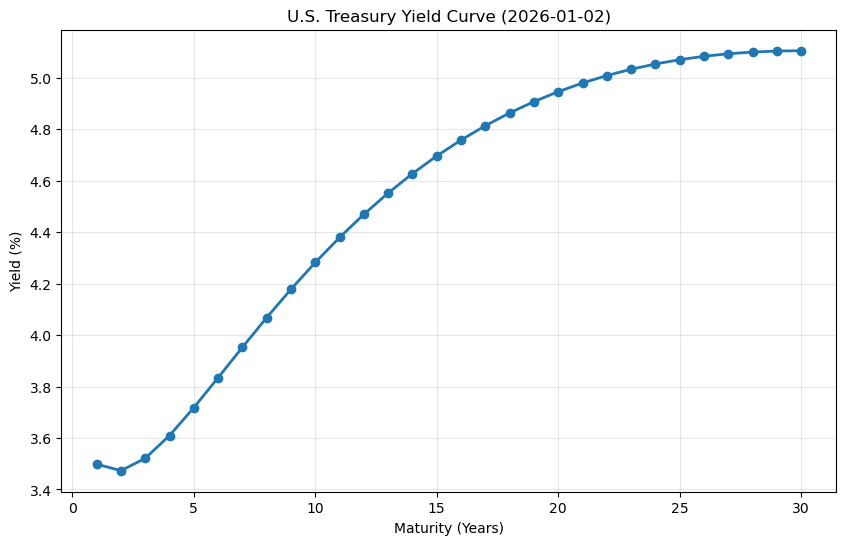
The GSW (Gurkaynak, Sack, Wright) yield curve provides:
Zero-coupon yields for maturities 1-30 years
Nelson-Siegel-Svensson model parameters
Note: These are yields, not returns.
# Load Federal Reserve yield curve data with auto-pull
yields = federal_reserve.load(
    data_dir=DATA_DIR,
    variant="standard",
    pull_if_not_found=True,
    accept_license=True,
).to_pandas()
yields = yields.set_index("Date")

print(f"Yield curve shape: {yields.shape}")
print(f"Columns: {yields.columns}")
yields.head()
Yield curve shape: (16843, 30)
Columns: Index(['SVENY01', 'SVENY02', 'SVENY03', 'SVENY04', 'SVENY05', 'SVENY06',
       'SVENY07', 'SVENY08', 'SVENY09', 'SVENY10', 'SVENY11', 'SVENY12',
       'SVENY13', 'SVENY14', 'SVENY15', 'SVENY16', 'SVENY17', 'SVENY18',
       'SVENY19', 'SVENY20', 'SVENY21', 'SVENY22', 'SVENY23', 'SVENY24',
       'SVENY25', 'SVENY26', 'SVENY27', 'SVENY28', 'SVENY29', 'SVENY30'],
      dtype='object')
| SVENY01 | SVENY02 | SVENY03 | SVENY04 | SVENY05 | SVENY06 | SVENY07 | SVENY08 | SVENY09 | SVENY10 | ... | SVENY21 | SVENY22 | SVENY23 | SVENY24 | SVENY25 | SVENY26 | SVENY27 | SVENY28 | SVENY29 | SVENY30 | |
|---|---|---|---|---|---|---|---|---|---|---|---|---|---|---|---|---|---|---|---|---|---|
| Date | |||||||||||||||||||||
| 1961-06-14 | 2.9825 | 3.3771 | 3.5530 | 3.6439 | 3.6987 | 3.7351 | 3.7612 | NaN | NaN | NaN | ... | NaN | NaN | NaN | NaN | NaN | NaN | NaN | NaN | NaN | NaN |
| 1961-06-15 | 2.9941 | 3.4137 | 3.5981 | 3.6930 | 3.7501 | 3.7882 | 3.8154 | NaN | NaN | NaN | ... | NaN | NaN | NaN | NaN | NaN | NaN | NaN | NaN | NaN | NaN |
| 1961-06-16 | 3.0012 | 3.4142 | 3.5994 | 3.6953 | 3.7531 | 3.7917 | 3.8192 | NaN | NaN | NaN | ... | NaN | NaN | NaN | NaN | NaN | NaN | NaN | NaN | NaN | NaN |
| 1961-06-19 | 2.9949 | 3.4386 | 3.6252 | 3.7199 | 3.7768 | 3.8147 | 3.8418 | NaN | NaN | NaN | ... | NaN | NaN | NaN | NaN | NaN | NaN | NaN | NaN | NaN | NaN |
| 1961-06-20 | 2.9833 | 3.4101 | 3.5986 | 3.6952 | 3.7533 | 3.7921 | 3.8198 | NaN | NaN | NaN | ... | NaN | NaN | NaN | NaN | NaN | NaN | NaN | NaN | NaN | NaN |
5 rows × 30 columns
# Plot yield curve snapshot for the most recent date
latest_date = yields.index.max()
latest_yields = yields.loc[latest_date]

maturities = [int(col.replace("SVENY", "")) for col in latest_yields.index]

plt.figure(figsize=(10, 6))
plt.plot(maturities, latest_yields.values, "o-", linewidth=2, markersize=6)
plt.xlabel("Maturity (Years)")
plt.ylabel("Yield (%)")
plt.title(f"U.S. Treasury Yield Curve ({latest_date.strftime('%Y-%m-%d')})")
plt.grid(True, alpha=0.3)
plt.show()
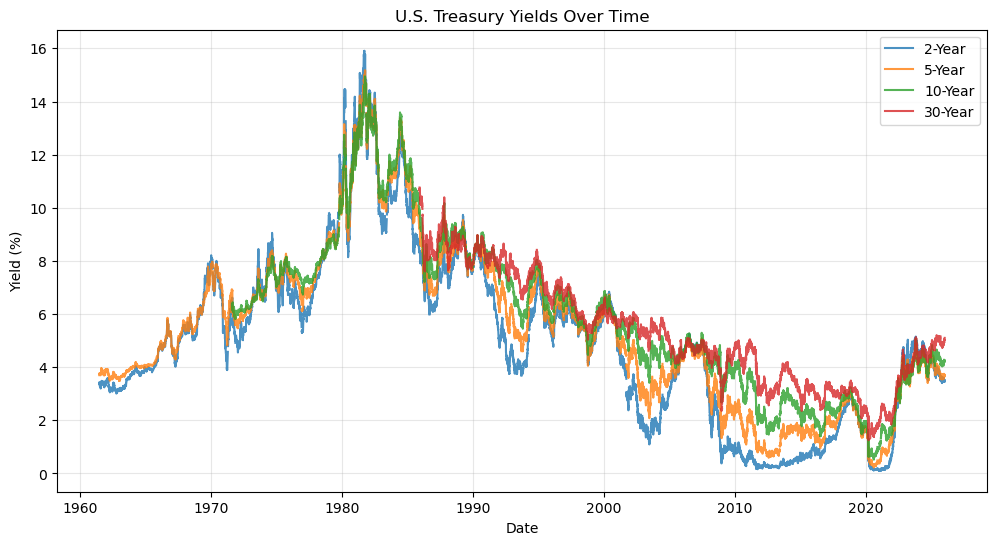
# Plot time series of key maturities
key_maturities = ["SVENY02", "SVENY05", "SVENY10", "SVENY30"]
labels = ["2-Year", "5-Year", "10-Year", "30-Year"]

plt.figure(figsize=(12, 6))
for col, label in zip(key_maturities, labels):
    if col in yields.columns:
        plt.plot(yields.index, yields[col], label=label, alpha=0.8)

plt.xlabel("Date")
plt.ylabel("Yield (%)")
plt.title("U.S. Treasury Yields Over Time")
plt.legend()
plt.grid(True, alpha=0.3)
plt.show()
3. He-Kelly-Manela Intermediary Factors#
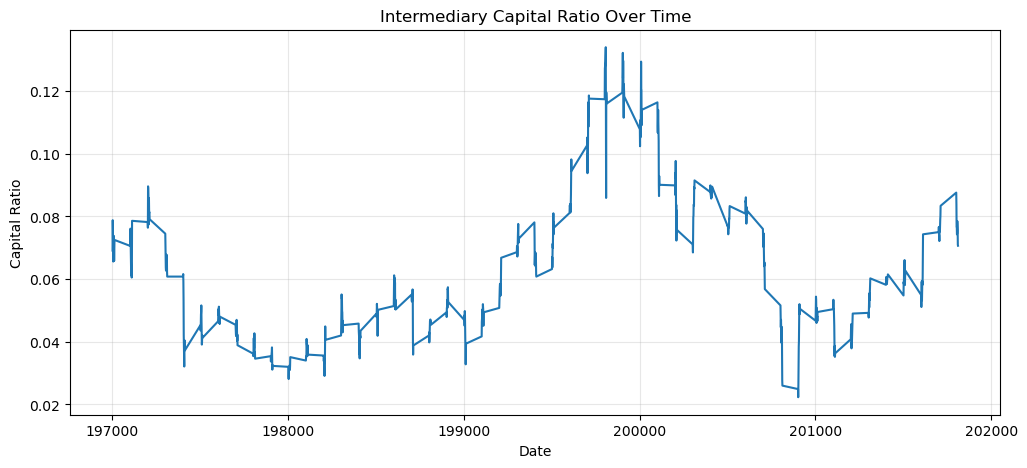
The HKM factors capture:
Intermediary capital ratio: Capital of financial intermediaries
Intermediary capital risk factor: Innovation in capital ratio
Note: These are factors, not asset returns.
# Load He-Kelly-Manela data with auto-pull
hkm_monthly = he_kelly_manela.load(
    data_dir=DATA_DIR,
    variant="factors_monthly",
    pull_if_not_found=True,
    accept_license=True,
).to_pandas()
hkm_monthly = hkm_monthly.set_index("yyyymm")

print(f"HKM monthly factors shape: {hkm_monthly.shape}")
print(f"Columns: {hkm_monthly.columns}")
hkm_monthly.head()
HKM monthly factors shape: (587, 5)
Columns: Index(['intermediary_capital_ratio', 'intermediary_capital_risk_factor',
       'intermediary_value_weighted_investment_return',
       'intermediary_leverage_ratio_squared', 'date'],
      dtype='object')
| intermediary_capital_ratio | intermediary_capital_risk_factor | intermediary_value_weighted_investment_return | intermediary_leverage_ratio_squared | date | |
|---|---|---|---|---|---|
| yyyymm | |||||
| 197001 | 0.0691 | -0.0727 | -0.0960 | 209.1790 | 1970-01-01 |
| 197002 | 0.0788 | 0.1416 | 0.1486 | 161.1352 | 1970-02-01 |
| 197003 | 0.0756 | -0.0360 | -0.0088 | 174.8429 | 1970-03-01 |
| 197004 | 0.0688 | -0.0870 | -0.1050 | 211.3283 | 1970-04-01 |
| 197005 | 0.0656 | -0.0440 | -0.0469 | 232.2706 | 1970-05-01 |
# Plot intermediary capital ratio
if "intermediary_capital_ratio" in hkm_monthly.columns:
    plt.figure(figsize=(12, 5))
    plt.plot(hkm_monthly.index, hkm_monthly["intermediary_capital_ratio"])
    plt.xlabel("Date")
    plt.ylabel("Capital Ratio")
    plt.title("Intermediary Capital Ratio Over Time")
    plt.grid(True, alpha=0.3)
    plt.show()
elif "capital_ratio" in hkm_monthly.columns:
    plt.figure(figsize=(12, 5))
    plt.plot(hkm_monthly.index, hkm_monthly["capital_ratio"])
    plt.xlabel("Date")
    plt.ylabel("Capital Ratio")
    plt.title("Intermediary Capital Ratio Over Time")
    plt.grid(True, alpha=0.3)
    plt.show()
else:
    print("Available columns:", list(hkm_monthly.columns))
4. Open Source Bond Returns#
The Open Bond Asset Pricing project provides:
Treasury bond returns: Government bond returns
Corporate bond monthly returns: Monthly returns with 108 factor signals
Corporate bond daily prices: Daily prices from TRACE Stage 1
These are asset returns that can be used for factor analysis.
# Load treasury returns with auto-pull if not found locally
treasury = open_source_bond.load(
    data_dir=DATA_DIR,
    variant="treasury",
    pull_if_not_found=True,
    accept_license=True,
).to_pandas()
print(f"Treasury returns shape: {treasury.shape}")
print(f"Treasury columns: {list(treasury.columns[:10])}...")
Treasury returns shape: (2381340, 5)
Treasury columns: ['DATE', 'CUSIP', 'tr_return', 'tr_ytm_match', 'tau']...
# Load corporate bond returns (monthly with factor signals) with auto-pull
corporate = open_source_bond.load(
    data_dir=DATA_DIR,
    variant="corporate_monthly",
    pull_if_not_found=True,
    accept_license=True,
).to_pandas()
print(f"Corporate returns shape: {corporate.shape}")
print(f"Corporate columns: {list(corporate.columns[:10])}...")
corporate.head()
Corporate returns shape: (1859546, 140)
Corporate columns: ['cusip', 'date', 'issuer_cusip', 'permno', 'permco', 'gvkey', '144a', 'country', 'call', 'ret_vw']...
| cusip | date | issuer_cusip | permno | permco | gvkey | 144a | country | call | ret_vw | ... | imom1 | imom3_1 | imom12_1 | iltr48_12 | iltr30_6 | iltr24_3 | var_90 | es_90 | var_95 | str | |
|---|---|---|---|---|---|---|---|---|---|---|---|---|---|---|---|---|---|---|---|---|---|
| 0 | 000336AE7 | 2002-08-31 | 000336 | 75188.0 | NaN | NaN | 0 | USA | 1 | 0.007252 | ... | 0.009089 | 0.016714 | 0.070078 | 0.259947 | 0.250910 | 0.202824 | 0.032174 | 0.035203 | 0.038233 | 0.051041 |
| 1 | 000336AE7 | 2002-09-30 | 000336 | 75188.0 | NaN | NaN | 0 | USA | 1 | -0.054660 | ... | 0.015736 | 0.024968 | 0.075254 | 0.263304 | 0.213676 | 0.196803 | 0.038233 | 0.046446 | 0.054660 | -0.002936 |
| 2 | 000336AE7 | 2002-10-31 | 000336 | 75188.0 | NaN | NaN | 0 | USA | 1 | 0.051999 | ... | 0.014274 | 0.030234 | 0.067641 | 0.295979 | 0.237394 | 0.206790 | 0.038233 | 0.046446 | 0.054660 | 0.066941 |
| 3 | 000336AE7 | 2002-11-30 | 000336 | 75188.0 | NaN | NaN | 0 | USA | 1 | 0.080557 | ... | 0.001263 | 0.015555 | 0.075689 | 0.260612 | 0.262213 | 0.207362 | 0.038233 | 0.046446 | 0.054660 | 0.045280 |
| 4 | 000336AE7 | 2003-04-30 | 000336 | 75188.0 | NaN | NaN | 0 | USA | 1 | 0.067899 | ... | 0.005471 | 0.018439 | 0.120662 | 0.257004 | 0.244847 | 0.196972 | 0.038233 | 0.046446 | 0.054660 | 0.053730 |
5 rows × 140 columns
# Plot treasury returns if available
if "bond_ret" in treasury.columns:
    # Aggregate treasury returns
    treasury_agg = treasury.groupby("date")["bond_ret"].mean()

    plt.figure(figsize=(12, 5))
    cumulative = (1 + treasury_agg).cumprod()
    plt.plot(cumulative.index, cumulative.values)
    plt.xlabel("Date")
    plt.ylabel("Cumulative Return")
    plt.title("Average Treasury Bond Cumulative Returns")
    plt.grid(True, alpha=0.3)
    plt.show()
elif "ret" in treasury.columns:
    treasury_agg = treasury.groupby("date")["ret"].mean()

    plt.figure(figsize=(12, 5))
    cumulative = (1 + treasury_agg).cumprod()
    plt.plot(cumulative.index, cumulative.values)
    plt.xlabel("Date")
    plt.ylabel("Cumulative Return")
    plt.title("Average Treasury Bond Cumulative Returns")
    plt.grid(True, alpha=0.3)
    plt.show()
else:
    print("Treasury columns:", list(treasury.columns))
Treasury columns: ['DATE', 'CUSIP', 'tr_return', 'tr_ytm_match', 'tau']
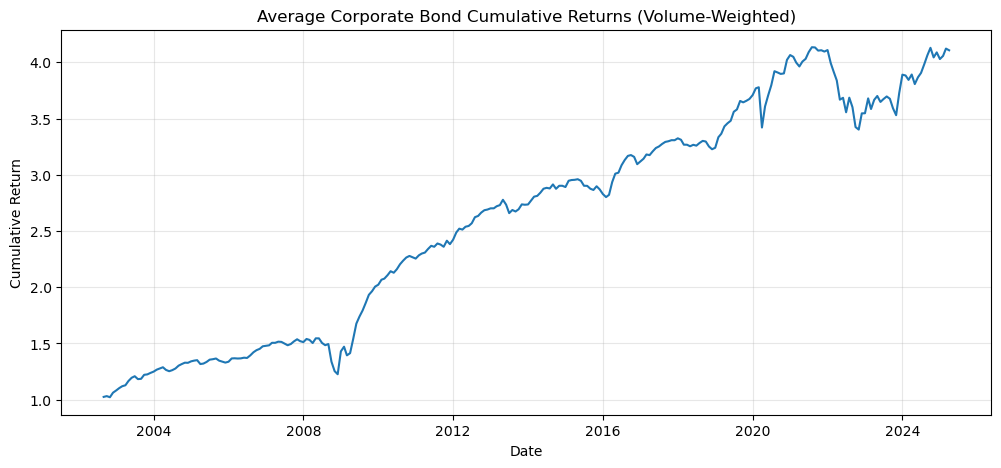
# Plot corporate bond returns
# Note: Monthly corporate data uses ret_vw (volume-weighted total return)
ret_col = "ret_vw" if "ret_vw" in corporate.columns else "bond_ret"
if ret_col in corporate.columns:
    # Aggregate corporate returns by date (equal-weighted across bonds)
    corp_agg = corporate.groupby("date")[ret_col].mean()

    plt.figure(figsize=(12, 5))
    cumulative = (1 + corp_agg.dropna()).cumprod()
    plt.plot(cumulative.index, cumulative.values)
    plt.xlabel("Date")
    plt.ylabel("Cumulative Return")
    plt.title("Average Corporate Bond Cumulative Returns (Volume-Weighted)")
    plt.grid(True, alpha=0.3)
    plt.show()
else:
    print("Corporate columns:", list(corporate.columns))
5. Factor Analysis (Asset Returns Only)#
We calculate factor exposures for bond returns against the Fama-French factors. This analysis only applies to asset return data (Open Source Bond), not to yields (Federal Reserve) or factor data (HKM).
# Prepare Fama-French factors for merging
# Resample to monthly if needed for bond data
ff_monthly = ff_factors.resample("ME").last()
print(f"Monthly FF factors shape: {ff_monthly.shape}")
Monthly FF factors shape: (59, 4)
# Calculate factor exposures for corporate bonds
# Note: Monthly corporate data uses ret_vw (volume-weighted total return)
corp_ret_col = "ret_vw" if "ret_vw" in corporate.columns else "bond_ret"
if corp_ret_col in corporate.columns and "date" in corporate.columns:
    # Aggregate corporate returns by date (equal-weighted portfolio)
    corp_monthly = corporate.groupby("date")[corp_ret_col].mean()
    corp_monthly.index = pd.to_datetime(corp_monthly.index)

    # Resample to month-end to align with FF factors
    corp_monthly = corp_monthly.resample("ME").mean()

    # Calculate factor exposures
    exposures_corp = finm.calculate_factor_exposures(
        corp_monthly,
        ff_monthly,
        annualization_factor=12.0,  # Monthly data
    )

    print("\nCorporate Bond Factor Exposures:")
    print("-" * 40)
    for key, value in exposures_corp.items():
        print(f"  {key}: {value:.4f}")
Corporate Bond Factor Exposures:
----------------------------------------
  average_return: 0.0052
  volatility: 0.0755
  sharpe_ratio: 0.0511
  market_beta: 1.0169
  smb_beta: -1.3948
  hml_beta: 0.0425
# Calculate factor exposures for treasury bonds
if "bond_ret" in treasury.columns:
    # Aggregate treasury returns by date
    treas_monthly = treasury.groupby("date")["bond_ret"].mean()
    treas_monthly.index = pd.to_datetime(treas_monthly.index)
    treas_monthly = treas_monthly.resample("ME").mean()

    exposures_treas = finm.calculate_factor_exposures(
        treas_monthly, ff_monthly, annualization_factor=12.0
    )

    print("\nTreasury Bond Factor Exposures:")
    print("-" * 40)
    for key, value in exposures_treas.items():
        print(f"  {key}: {value:.4f}")
elif "ret" in treasury.columns:
    treas_monthly = treasury.groupby("date")["ret"].mean()
    treas_monthly.index = pd.to_datetime(treas_monthly.index)
    treas_monthly = treas_monthly.resample("ME").mean()

    exposures_treas = finm.calculate_factor_exposures(
        treas_monthly, ff_monthly, annualization_factor=12.0
    )

    print("\nTreasury Bond Factor Exposures:")
    print("-" * 40)
    for key, value in exposures_treas.items():
        print(f"  {key}: {value:.4f}")
# Summary comparison table
if "exposures_corp" in dir() and "exposures_treas" in dir():
    summary = pd.DataFrame(
        {
            "Corporate Bonds": exposures_corp,
            "Treasury Bonds": exposures_treas,
        }
    ).T

    print("\nFactor Exposure Comparison:")
    print("=" * 60)
    print(summary.to_string())
6. WRDS Data (Optional)#
WRDS data requires authentication. This section is skipped if credentials are not available.
# Check for WRDS credentials
WRDS_USERNAME = os.environ.get("WRDS_USERNAME", "")

if WRDS_USERNAME:
    print(f"WRDS username found: {WRDS_USERNAME}")
    print("WRDS data pull is available but skipped in this notebook.")
    print("To pull WRDS data, use:")
    print("  from finm.data import wrds")
    print(
        "  wrds.pull(data_dir=DATA_DIR, variant='treasury', wrds_username=WRDS_USERNAME)"
    )
else:
    print("WRDS credentials not found.")
    print("To use WRDS data, set the WRDS_USERNAME environment variable:")
    print("  export WRDS_USERNAME=your_username")
    print("Or add to your .env file:")
    print("  WRDS_USERNAME=your_username")
WRDS username found: jmbejara
WRDS data pull is available but skipped in this notebook.
To pull WRDS data, use:
  from finm.data import wrds
  wrds.pull(data_dir=DATA_DIR, variant='treasury', wrds_username=WRDS_USERNAME)
Summary#
This notebook demonstrated:
Fama-French Factors: Loaded and visualized the 3-factor model data
Federal Reserve Yield Curve: Downloaded GSW yields and plotted the term structure
He-Kelly-Manela Factors: Pulled intermediary capital factor data
Open Source Bond Returns: Downloaded treasury and corporate bond returns
Factor Analysis: Calculated factor exposures for bond returns
All data sources follow the standardized interface:
pull(data_dir, accept_license=True): Download data from sourceload(data_dir, variant, pull_if_not_found, accept_license): Load cached data (returns polars DataFrame)to_long_format(df): Convert to long format
Note: When using pull_if_not_found=True, you must also set accept_license=True
to acknowledge the data provider’s licensing terms. See each module’s LICENSE_INFO for details.